The oldest known image of a saffron harvest isn't a photograph, and it isn't a painting on canvas. It's a fresco, painted directly onto wet plaster on the island of Thera, now Santorini, around 1650 BC. Archaeologists found it in a building known as Xeste 3 at Akrotiri, preserved almost intact by the volcanic ash that also ended the settlement. It shows women picking flowers by hand and placing the stigmas into baskets, the same task, done the same way, that still opens every saffron harvest today.
The fresco
What makes the Akrotiri fresco worth pausing on isn't just its age. It's how little translation it needs. The gesture in the plaster, fingers reaching into an open crocus bloom to lift out the stigmas, is instantly recognisable to anyone who has picked saffron since, because it's still the only way to do it. No tool has ever replaced that motion. The flower's short bloom window and the fragility of the stigmas themselves have kept it a hand task for roughly 3,600 years.
A flower that can't reproduce
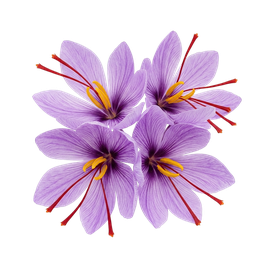
There's a reason the technique in that fresco has never needed to change. Crocus sativus, the saffron crocus, is a triploid plant, meaning it carries three sets of chromosomes instead of the usual two. Genetic research traces its origin to Attica, Greece, where it arose as a hybrid of a wild ancestor, Crocus cartwrightianus. That extra set of chromosomes makes the plant sterile. It produces no viable seed, so it can't be grown from seed the way most crops are. Every corm, the bulb-like structure the plant grows from, has to be dug up, divided by hand, and replanted to produce the next generation.
Chromosome-level imaging from a separate study confirmed the same picture from a different angle: every cultivated saffron crocus alive today is, genetically, a copy of the last one, hand-propagated back to that original hybrid.
What "unchanged" actually means for the flower we grow
This is what makes "unchanged" more than a nice phrase. The flower blooming on a saffron field today isn't a distant descendant of the one in the fresco, bred and adjusted over centuries the way most crops have been. It's the same genetic line, divided and replanted by hand, generation after generation, for roughly 3,600 years. The bloom window is still a matter of days each autumn. The three stigmas are still lifted from the flower by hand, one at a time, because nothing has replaced that step. What has changed since the Bronze Age isn't the flower or the harvest. It's everything that happens after: how quickly the threads are dried, how they're stored, and whether anyone actually tests what ends up in the jar.

Why this is worth knowing before you buy
If the flower and the harvest are effectively fixed, the differences you notice between saffron brands aren't coming from the plant. They're coming from decisions made after picking: how fast the threads were dried, how they were stored, and whether the batch was tested rather than just labelled. That's the part of the process ISO 3632 grading exists to check, and it's why RedGold88™ Extract and Reserve Threads are both independently tested against it, rather than sold on the strength of the flower's history alone.